


Can hydroxypropyl methyl cellulose be used as an additive in animal feed?
21 October, 2026
You see HPMC in food almost every day, even if you do not know it. Hydroxypropyl methylcellulose helps food makers a lot. It can make foods thicker, mix things together, and keep them stable. You can find it in bread, dairy foods, and plant-based foods. It helps these foods feel better and stay moist.
HPMC helps make sauces, soups, and gravies thicker. It mixes with water and gives food a smooth feel. This keeps food together and stops things from separating. Scientists say hydrocolloids like HPMC help foods get thick and gel-like. You can see this in jellies and dressings.
Tip: Use HPMC if you want thick sauces that do not separate.
HPMC is special because it dissolves in cold water and makes a clear mix. It works better than methylcellulose or ethylcellulose. HPMC also helps food last longer because it stops germs from growing.
| Study Title | Key Findings |
| Effects of thickening agents on the formation and properties of edible oleogels based on hydroxypropyl methyl cellulose | HPMC is a common polysaccharide that keeps oil and water mixed. It is good for thickening and stabilizing food. |
HPMC helps oil and water mix in foods. This is important for things like salad dressings and mayonnaise. HPMC keeps the mix smooth and stops it from splitting. It also makes a thin, clear layer that covers food and keeps it fresh.
| Property/Function | Description |
| Emulsifier | HPMC helps keep oil and water mixed in foods. |
| Film-forming | HPMC can make a clear, oil-proof, and water-friendly film for food. |
| Mechanical properties | The films are strong and work well in many foods. |
| Barrier properties | HPMC films block oxygen and slow down water vapor. |
| Film Type | Properties |
| HPMC/WPI Edible Films | These films show HPMC helps make good food coatings. |
Note: HPMC films you can eat help keep food safe and fresh longer.
You can see HPMC’s film in coated nuts, candies, and frozen foods. These films keep out water and air, so flavors stay fresh.
HPMC helps food stay moist and feel nice to eat. You can use it in frozen foods, baked goods, and dairy-free foods. Freezing can make food dry and change its texture. HPMC makes a barrier around food, stopping ice from hurting it. This keeps food moist and tasty after thawing.
Hydroxypropyl methylcellulose works as a cryoprotectant, stabilizer, and emulsifier. It makes ice cream and frozen desserts smoother. HPMC also keeps sauces and gravies creamy and stops them from splitting.
Block Quote: HPMC helps food feel better, taste better, and last longer in many foods, like sauces and frozen desserts.

When you use HPMC in food, you need to know how it dissolves and how thick it makes your product. HPMC dissolves in cold water and forms a clear, thick solution. It does not dissolve in hot water. You can use it in many recipes because it works in a wide pH range from 3 to 11. This means you can add it to both sour and neutral foods.
Here is a table that shows the main solubility and viscosity features:
| Parameter | Description |
| Water Solubility | Dissolves in cold water, forms a colloidal solution. Not soluble in hot water. |
| pH Sensitivity | Works in pH 3 to 11, so it fits many food types. |
| Solubility in Mixtures | Dissolves in water and some water-mixed solvents. |
| Viscosity in Cold Water | Makes a thick, clear solution at 2-3% in cold water (20°C). |
| Gel Formation | Forms a gel when heated above 60°C. |
The thickness, or viscosity, changes with the amount and type of HPMC you use. If you use more, your food gets thicker. This helps you control the texture and mouthfeel. You can make sauces creamy or desserts smooth. If you change the temperature, the thickness can also change. You need to watch this during cooking to keep your food stable and tasty.
HPMC has a special property called thermal gelation. When you heat it, the molecules link together and form a gel. This gel traps water and oil, which helps foods like vegan eggs or omelets hold their shape and stay moist.
| Mechanism of Thermal Gelation | Impact on Food Applications |
| Molecules form a 3D network as temperature rises. | Improves texture, keeps moisture, and helps oil stick in foods like vegan eggs. |
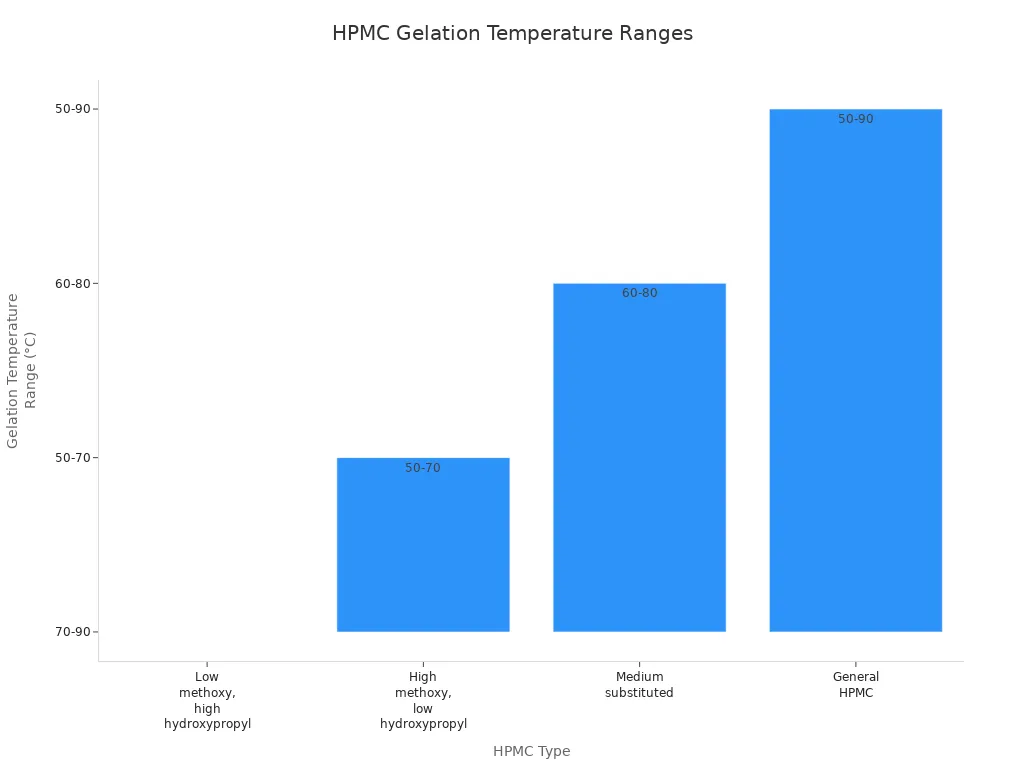
You can see how different types of HPMC gel at different temperatures:
| Type of HPMC | Gelation Temperature Range (°C) |
| Low methoxy, high hydroxypropyl (F type) | 70-90 |
| High methoxy, low hydroxypropyl (E type) | 50-70 |
| Medium substituted (K type) | 60-80 |
| General range | 50-90 |
When you fry or bake foods with HPMC, the gel stops water from escaping and helps oil stick to the food. This makes your food juicy and gives it a better bite. You can use this property to make plant-based foods that taste and feel like real eggs or meat.
Tip: Try different types of HPMC to match the gelation temperature to your recipe.
When you choose HPMC in food formulas, you need to look at several important factors. Each type of HPMC has different properties that affect how your food turns out. You want to pick the right grade for your recipe so you get the best texture and stability.
| Criteria | Description |
| Molecular Weight | Higher molecular weight gives thicker texture and stronger films. |
| Degree of Substitution | More substitution means better water retention and stickiness. |
| Viscosity | Controls how thick or smooth your food feels. |
| Particle Size | Smaller particles dissolve faster and mix better. |
| Moisture Content | Lower moisture helps HPMC flow and stay stable in your mix. |
You can use low-viscosity HPMC for sauces and soups to improve texture. Medium-viscosity HPMC works well in dressings and frozen desserts because it helps stabilize and emulsify. High-viscosity HPMC is best for bakery fillings and dairy desserts, giving them a firm and stable texture.
Tip: Always match the viscosity grade to your food application for the best results.
You must control how much HPMC you add to your food. Using the right amount helps you get the texture you want without making food too gummy or slimy. Most recipes use HPMC in food at levels between 0.1% and 1.0%. For bread and pastries, you can use 0.3% to 0.6%. Dairy products often need 0.2% to 0.5%. Sauces and beverages work well with 0.1% to 0.5%.
| Food Product Type | Recommended Dosage Range |
| General Use | 0.1% – 1.0% |
| Thickener (sauces, jellies, beverages) | 0.1% – 0.5% |
| Bread and pastries | 0.3% – 0.6% |
| Dairy products | 0.2% – 0.5% |
To dissolve HPMC, you should sprinkle the powder into cold water and stir for 10-20 minutes. This helps prevent lumps and gives you a smooth mix. You can also add HPMC to hot water, then cool it down while stirring. This method helps hydrate the powder slowly.
You need to test your formula to avoid unwanted textures. HPMC can change mouthfeel, so balance it with other ingredients. Watch for interactions with acids or enzymes, which can affect stability. Also, remember that HPMC costs more than some other thickeners.
Note: Start with a small amount and increase slowly until you reach the texture you want.
You can boost food quality by combining HPMC with proteins and starches. HPMC works with proteins in bread and other baked goods to improve texture and keep bread fresh longer. When you add HPMC, you help bread rise higher and stay softer. The table below shows how HPMC interacts with bread ingredients:
| Parameter Assessed | Description |
| Microstructure Analysis | HPMC links with bread proteins, helping prevent staling. |
| Physical Parameters | You see better volume, shape, moisture, and less hardness. |
| Crumb Structure | More air cells and better crumb texture appear with HPMC. |
| Sensory Evaluation | Bread looks, smells, and tastes better. |
| Conclusion | HPMC boosts bread volume and texture by working with proteins and starch. |
HPMC also changes how starch behaves in foods. You get thicker sauces and more stable gels when you use HPMC with starch. Here are some ways HPMC interacts with starches:
Note: You should always test your recipe because pH, salts, and other ingredients can change how HPMC works.
HPMC helps you keep food fresh and appealing for longer. It forms a barrier that blocks moisture and oxygen, which slows down spoilage. You can use HPMC coatings on fruits, baked goods, and snacks to protect them. The table below highlights HPMC’s benefits for shelf life:
| Application | Benefit |
| Edible Films & Packaging | HPMC films keep out moisture and oxygen, making food last longer. |
| Coatings on Apples | HPMC slows down firmness loss and color change, keeping apples fresh during storage. |
You also improve how food looks, feels, and tastes with HPMC. Foods stay moist, soft, and flavorful. HPMC keeps sauces from separating and helps bread stay soft. You may notice that HPMC can react with some ingredients, like salts or acids, which can change its performance. Sometimes, HPMC may cause cloudiness or lumps if it meets certain metal ions or surfactants. You should check your formula and adjust as needed.
Tip: Always test your food formula with HPMC to make sure you get the best shelf life and taste.
You might wonder if HPMC is safe to eat. Food safety groups around the world have checked HPMC. They made rules to keep people safe. The table below shows what big agencies think about HPMC:
| Authority | Classification | Notes |
| FDA | Generally Recognized as Safe (GRAS) | Many studies show HPMC is safe to eat. |
| EFSA | Approved for use in food applications | High amounts may upset your stomach, but it is not a big health risk. |
Most people can eat HPMC without problems. Here are some facts about HPMC and allergies:
Note: Allergies to HPMC do not happen often, but always listen to your body.
HPMC is allowed in many places. Food safety groups in the US and Europe say it is safe. They let companies use it in lots of foods.
| Region | Regulatory Authority | Approval Status |
| US | FDA | Approved |
| EU | EFSA | Approved |
| Asia | N/A | Not specified |
You can use HPMC to make foods thicker or smoother. Many brands pick HPMC because it works for vegan and gluten-free foods. You should know about food labels too. Groups like the FDA and EFSA say HPMC must be listed on labels. This helps you know what is in your food. Labels may also say non-GMO, gluten-free, or allergen-free so you can choose safely.
Tip: Check labels and ingredient lists so you know what is in your food.
You can notice HPMC makes dough stronger and bread softer. It helps bread keep its moisture and stay fresh longer. The crumb is softer and sticks together better.
To use HPMC safely, you should:
Scientists are finding new ways to use HPMC, like smart films that show spoilage by changing color:
| Application | Benefit |
| Sensing Platform | Finds bacteria and spoilage in foods |
| pH Sensitivity | Changes color with pH to check freshness |
Keep learning about new rules and try new ideas with HPMC in your food!
You see HPMC in bread, sauces, ice cream, and plant-based foods. Food makers use it to make products thicker, smoother, and longer-lasting. You also find it in gluten-free and vegan foods.
You can eat HPMC safely. Food safety groups like the FDA and EFSA approve it for use in foods. Most people do not have allergic reactions. If you feel sick, talk to your doctor.
You should sprinkle HPMC into cold water and stir well. This helps it dissolve without lumps. Start with a small amount and test your recipe for the best texture.
HPMC does not add flavor. You will not taste it in your food. It helps improve texture and keeps food moist, but it does not change how food tastes.
Yes! You can use HPMC in vegan and gluten-free recipes. It helps replace eggs and gluten, making foods soft and stable. Many brands choose HPMC for these products.


