


Can hydroxypropyl methyl cellulose be used as an additive in animal feed?
21 October, 2026
You can tell hydroxypropyl methylcellulose by its chemical formula, C56H108O30. This compound is a white powder. It does not have a smell. It mixes well with water. Its chemical structure has hydrophobic methyl groups. It also has hydrophilic hydroxypropyl groups. These groups are attached to a cellulose backbone. These groups help HPMC dissolve in water. They let it make thick, gel-like solutions. Because of this, HPMC is used in products that need strong viscoelasticity and stable films.
The main part of hydroxypropyl methylcellulose is its cellulose backbone. This backbone is made from glucose units joined by β-1,4-glycosidic bonds. These bonds make a long chain. In regular cellulose, each glucose has three hydroxyl groups. In HPMC, some hydroxyl groups are swapped for other groups. This swap makes HPMC different from natural cellulose.
HPMC has two main substituent groups: methoxy and hydroxypropyl. These groups attach to the cellulose backbone at positions 2, 3, or 6 on each glucose. To get these groups, cellulose is treated with an alkaline base. Then it reacts with methyl chloride and propylene oxide.
How these groups are spread along the backbone can change how HPMC dissolves or forms gels. If the groups are not spread evenly, the solution properties can be different.
Here is a table that shows how the degree and pattern of substitution affect HPMC:
| Property | Description |
| Solubility and Viscosity | More hydroxypropyl and methyl groups make HPMC dissolve better and get thicker. |
| Hydrophobicity | Methoxy groups make HPMC more hydrophobic than hydroxypropyl groups. |
| Mechanical Properties | More substitution can make films stronger and better at blocking moisture. |
| Distribution | If groups are not spread evenly, HPMC solutions or clumps can change. |
The size of HPMC molecules is called molecular weight. HPMC’s molecular weight usually goes from 20 to over 1,000 kg/mol. Scientists use size-exclusion chromatography and special detectors to measure this.
If you want HPMC for thickening or slow drug release, pick a higher molecular weight. For fast-dissolving coatings or films, a lower molecular weight is better.
The chemical structure, including the backbone, substituent groups, and molecular weight, all work together to give HPMC its special properties.
Hydroxypropyl methylcellulose mixes well with water. This is because of its special chemical structure. The cellulose backbone has hydrophobic methyl groups. It also has hydrophilic hydroxypropyl groups. These groups make HPMC amphiphilic. That means it can work with both water and oil. When you add HPMC to water, the hydrophilic parts pull in water molecules. This helps HPMC dissolve.
If you look at other cellulose derivatives, HPMC stands out for solubility. Methylcellulose only mixes with cold water. Carboxymethylcellulose mixes with both hot and cold water.
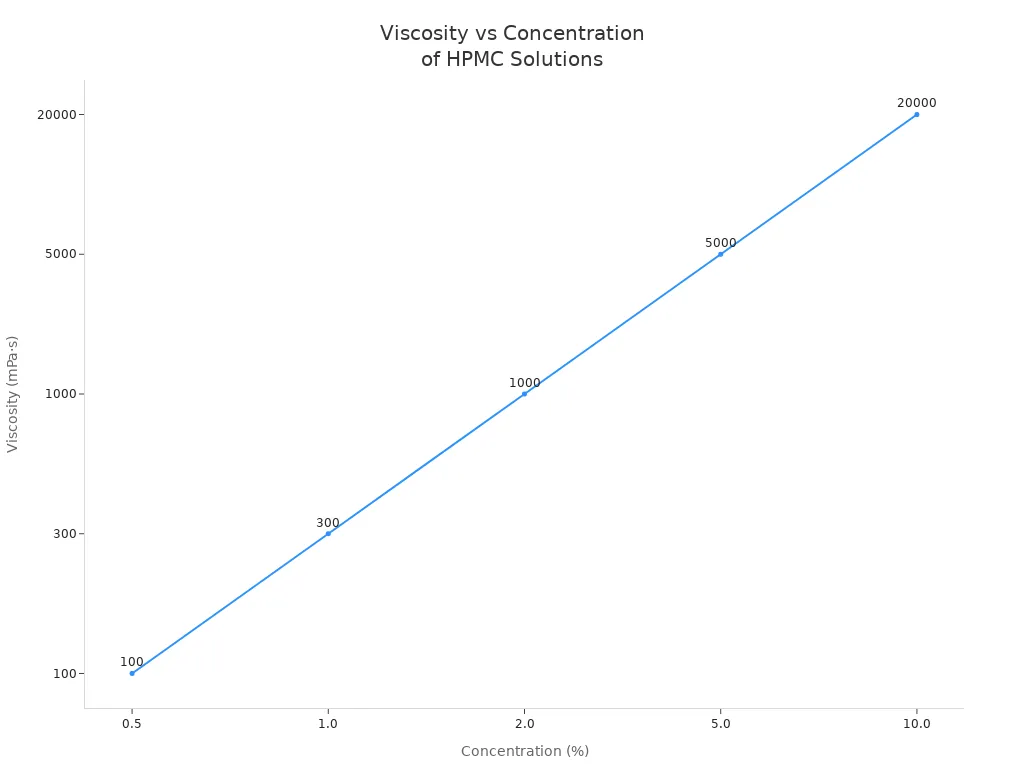
Adding HPMC to water makes the solution thick. The thickness depends on how much HPMC you use. It also depends on the molecular weight. Higher molecular weight means longer chains. These chains tangle and make the solution thicker. Using more HPMC makes it even thicker.
Here is a table that shows how thickness changes with concentration:
| Concentration (%) | Viscosity (mPa·s) |
| 0.5 | 100 |
| 1.0 | 300 |
| 2.0 | 1000 |
| 5.0 | 5000 |
| 10.0 | 20000 |
You can pick different viscosity grades for different jobs. High viscosity HPMC is good for building and food thickening. Low viscosity HPMC works well for coatings and medicine binders.
| Viscosity Grade | Viscosity Range (mPa·s) | Typical Applications |
| High Viscosity HPMC | Above 1,000 | Construction (tile adhesives, wall putty), Pharmaceuticals (controlled-release agent), Food (thickener), Cosmetics (texture enhancement) |
| Low Viscosity HPMC | Below 1,000 | Pharmaceuticals (binder in granulation), Personal Care (stabilizer in eye drops), Food (emulsifier in dairy products) |
The chemical structure, especially chain length and hydroxypropyl groups, controls thickness. HPMC solutions show viscoelasticity. This means they act like both a liquid and a soft solid. This helps in many uses.
HPMC can make strong, bendable films. You dissolve it in water and let it dry. It forms a gel network. This network spreads out and sticks to surfaces. The films are clear and smooth. They block moisture and gases. This makes them great for coatings, capsules, and food packaging.
HPMC films form better than methylcellulose or hydroxypropyl cellulose films.
| Cellulose Derivative | Film-Forming Ability |
| Hydroxypropyl Methylcellulose | Excellent, suitable for coating and protection |
| Methylcellulose | Good, but slightly inferior to HPMC |
| Hydroxypropyl Cellulose | Lower film-forming ability compared to HPMC |
The chemical structure, with balanced hydrophilic and hydrophobic groups, helps make strong films. These films stay stable in many pH levels and temperatures.
HPMC is safe for food, medicine, and personal care. It is gentle on the body. Its non-ionic nature means it does not react with other chemicals in your body. Tests show HPMC does not hurt cells. It causes almost no irritation.
| Evidence Type | Details |
| Regulatory Approval | HPMC is approved by the FDA, JECFA, and EU, classified as GRAS (Generally Recognized As Safe). |
| Cytotoxicity Assays | Testing with L929, MC3T3-E1, and HaCaT cells showed excellent biocompatibility (~0.5% haemolysis). |
| Biocompatibility Properties | HPMC offers superior biocompatibility and controlled degradation properties. |
HPMC is found in many products because it is safe. The FDA and European Union say it is okay for food and medicine. The Joint FAO/WHO Expert Committee on Food Additives also says it is safe. It has a high acceptable daily intake.
The chemical structure, with its non-ionic and stable backbone, helps keep HPMC safe. You can use it in tablets, eye drops, and foods without worry.
You will find hydroxypropyl methylcellulose (HPMC) in many building materials. HPMC helps cement-based mortars, tile adhesives, and self-leveling compounds work better. When you use HPMC, you get smoother mixes and stronger bonds. HPMC keeps water in the mix, so cement cures properly and does not dry too fast. This means your tiles stay in place and your walls last longer.
| Property | Benefit in Construction Materials |
| Water Retention | Prevents early drying and helps cement set correctly |
| Workability | Makes mortar easier to spread and shape |
| Adhesion | Improves how well materials stick together |
| Anti-Sagging | Keeps tiles and mortar from slipping during application |
You can see that construction uses over 40% of all HPMC sold worldwide. HPMC also makes buildings stronger and more durable. 🌍
You will see HPMC in many medicines. It acts as a binder in tablets, holding ingredients together. HPMC forms thin films for coatings and helps control how fast medicine releases in your body. When you take a tablet with HPMC, it can release the drug slowly, so you do not need to take it as often.
HPMC also works in eye drops and hand sanitizers as a thickener. You get better results and more comfort with these products.
You will find HPMC in foods like sauces, soups, and baked goods. It thickens, stabilizes, and keeps food moist. HPMC lets you enjoy low-fat foods that still taste good. It also gives a glossy finish to many products.
HPMC is safe for you to eat and use on your skin. The FDA and EU approve it for food and cosmetics. You can trust products with HPMC for quality and safety.
You can notice that the chemical structure of hydroxypropyl methylcellulose gives it special features. This structure decides how well it dissolves, how thick it gets, and how it forms films. These things are important for many uses. When picking HPMC, you should think about some main points:
| Key Point | Description |
| Substituent Distribution | The way groups are added changes how HPMC acts in different products. |
| Structural Differences | Even small changes in structure can make a big difference in what it does. |
Knowing how these things connect helps you pick the best material for what you need.
You can use HPMC safely in food, medicine, and cosmetics. Regulatory agencies like the FDA and EU approve it. Scientists test HPMC for safety. You will not find harmful effects at normal levels.
You can dissolve HPMC in cold water easily. Hot water may cause clumping. For best results, add HPMC slowly to cold water and stir well.
| Storage Tip | Details |
| Keep dry | Store in a sealed container. |
| Avoid sunlight | Place in a cool, dark area. |
| Use quickly | Use before the expiry date. |


