


Can hydroxypropyl methyl cellulose be used as an additive in animal feed?
21 October, 2026

You may ask how edible hpmc and methylcellulose are different in food. The biggest differences are in their gel strength, solubility, and how they work in recipes. Look at this table to compare them quickly:
| Property | HPMC | Methylcellulose |
| Molecular Weight | Higher, makes stronger gels | Lower, dissolves better in water |
| Degree of Substitution | Higher, gels better | Lower, dissolves more easily |
| Applications | Used in slow-release medicines | Used to thicken foods |
Edible hpmc helps you make foods with clean labels and no allergens. Both hpmc and methylcellulose can thicken, bind, and form films. They can also replace fat or gluten in recipes. New trends show you can use these for plant-based foods and for eco-friendly packaging.
You might see edible hpmc in many foods. It is a semi-synthetic compound. People make it by changing cellulose from plants. They add hydroxypropyl and methyl groups to the cellulose. This makes it water-soluble, non-ionic, and stable. Edible hpmc is safe to eat. The FDA and EFSA say it is okay for food. You can find edible hpmc in foods that need thickening or binding. It also helps form films in some foods.
Methylcellulose also comes from cellulose. Makers swap some hydroxyl groups for methyl groups. This gives methylcellulose a simpler structure than edible hpmc. Methylcellulose works well as a thickener and stabilizer. It is used in foods and medicines. It can dissolve in water, but not as fast as edible hpmc. Methylcellulose is safe to eat. You will find it in many processed foods.
Here is a table to help you compare their chemical structures and uses:
| Property | HPMC (Hydroxypropyl Methyl Cellulose) | Methylcellulose (MC) |
| Chemical Structure | Methyl + hydroxypropyl groups (complex) | Only methyl groups (simple) |
| Solubility | More soluble in water | Less soluble in water |
| Viscosity | Higher viscosity | Lower viscosity |
| Applications | Thickener, emulsifier, stabilizer in many industries | Thickener, stabilizer in food and pharma |
Both edible hpmc and methylcellulose start with pure cellulose. This cellulose comes from wood pulp or cotton. The steps to make them are:
You can trust these ingredients are pure. They meet strict rules from the FDA, EU, FAO/WHO, and others. Makers follow Good Manufacturing Practices. They have certifications like FSSC22000, ISO9001, and ISO14001. This means you get safe and high-quality products in your food.
When you look at edible hpmc and methylcellulose, you see they dissolve in water differently.
You pick one of these ingredients based on the texture you want in your food. Here is a table that shows their viscosity ranges:
| Food Application | Viscosity Range (mPa·s) |
| Bakery Products | 10,000–20,000 |
| Dairy and Beverages | 1,000–10,000 |
| Processed Foods | 20,000–50,000 |
Thermal stability and gelation temperature are important when you cook or process food.
| Polymer Type | Gelation Temperature (°C) |
| HPMC | 61 |
| Methylcellulose | 52 |
You may wonder what happens to these ingredients inside your body.
Tip: This makes them helpful as dietary fiber in some foods.

Edible hpmc is found in lots of foods. It helps make food smooth and stable. You see it in foods that need to stay fresh and taste good. Some foods with edible hpmc are:
Edible hpmc thickens and binds recipes. It is in creamy desserts and smooth sauces. Whipped toppings keep their shape because of it. Bakery fillings stay moist and stable with edible hpmc.
Edible hpmc gives many benefits to foods. It helps food last longer and keeps it good. Here are some ways it helps:
You can coat fruits and vegetables with edible hpmc. This coating helps them stay fresh longer. The film protects the food and keeps it stable. Foods with edible hpmc have better texture, color, and flavor. There is less spoilage and waste.
Tip: Edible hpmc helps you waste less food. Foods last longer, so you throw away less.
Here is a summary of the benefits:
| Benefit | How Edible hpmc Helps |
| Product quality | Keeps texture, color, and flavor |
| Shelf life | Makes a protective barrier |
| Food waste | Cuts down on spoilage and waste |
You pick edible hpmc when you want food to last and taste good. It helps you control how your food turns out.

Methylcellulose is in many foods you eat often. Food makers like it because it helps control how food feels and keeps it stable. Here is a table that shows where methylcellulose is used:
| Application Type | Description |
| Thickening and Stabilization | Used in sauces, dressings, and dairy alternatives to make them thicker and stop them from separating. |
| Gluten-Free Baking | Acts as a binder and helps dough stick together in gluten-free foods. |
| Fat Replacement | Makes low-fat foods feel creamy, so they taste good with fewer calories. |
| Emulsification | Helps mix fat evenly in salad dressings and ice cream. |
| Meat and Seafood Analogues | Holds plant-based meats together and gives them a chewy feel. |
| Encapsulation and Coating | Covers ingredients to keep them safe and make foods look better. |
You can use methylcellulose to make sauces thick and smooth. It helps gluten-free bread stay together and makes it easier to eat. If you want less fat in your food, methylcellulose keeps it creamy. It is also in plant-based meats to help them hold their shape and feel chewy.
Methylcellulose does more than just make food thick. It changes how food feels and cooks. Here are some important things to know:
Tip: You can use methylcellulose to make foods that look and taste like meat, but have less fat and more plants.
Methylcellulose helps you control how food feels and how much water it holds. This makes it a good choice for many new foods.
When you look at edible hpmc and methylcellulose, the degree of substitution (DS) is important. DS shows how many chemical groups replace the natural parts in cellulose. This change makes each ingredient act differently in food.
Here is a table with the usual substitution levels:
| Type | Methyl Content | Hydroxypropyl Content |
| Type C | High | High |
| Type D | High | Medium |
| Type E | Medium | Medium |
The substitution pattern also changes how these ingredients hold or release water and other things. For example:
Note: DS affects not just texture but also how well your food stays together and how it feels when you eat it.
You want to know if these ingredients are safe and approved. Both edible hpmc and methylcellulose have passed safety checks in many countries. Here is a table that shows how different places approve them:
| Region | Regulatory Body | Approval Process |
| EU | European Food Safety Authority (EFSA) | All health claims must be checked and added to EU rules. |
| US | FDA | Structure or function claims do not need pre-approval; claims can be used without a set list. |
| Canada | Health Canada | Function-type claims can be checked if asked; an example is a polysaccharide complex. |
| Australia/New Zealand | Food Standards Australia New Zealand | Claims must be told if not checked before use; proof is needed. |
Both ingredients are safe for most people. Some people may get mild side effects if they eat too much. These can be:
Most people do not have any problems with these ingredients. If you have allergies or are sensitive, check food labels and talk to your doctor.
Tip: Edible hpmc and methylcellulose are not common allergens. They are safe for people with gluten or dairy allergies.
You want your food to taste and look good. Edible hpmc and methylcellulose do not add much taste or smell. This helps the real flavors in your food stand out.
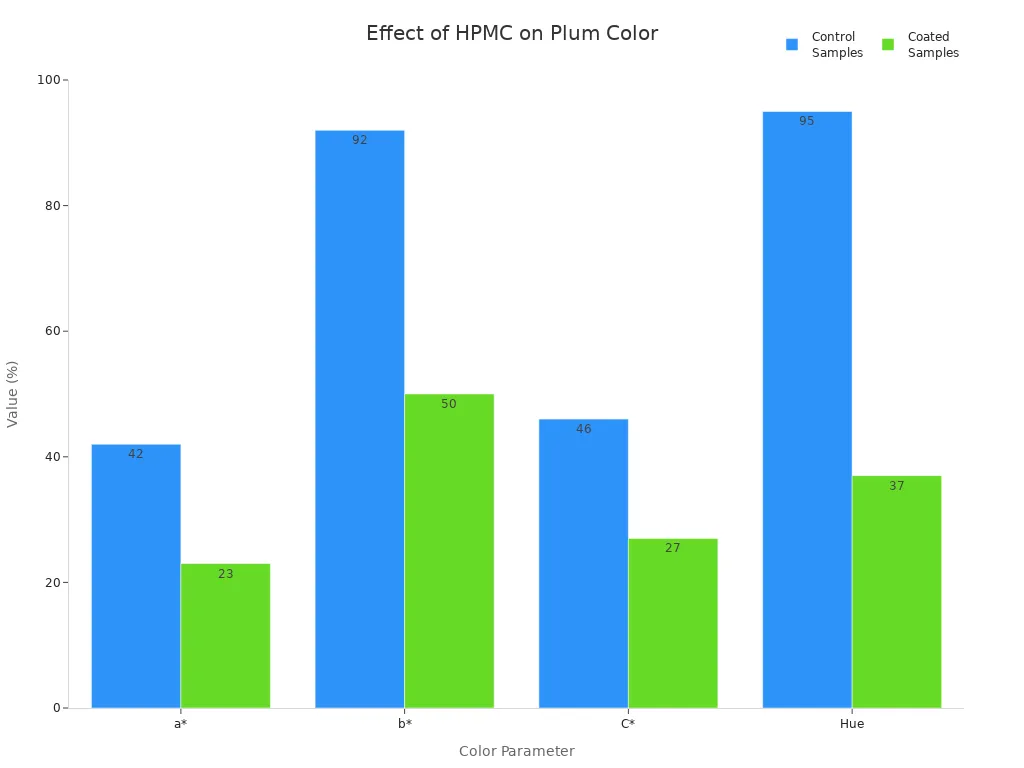
For color, edible hpmc helps fruits and other foods look fresh. Here is a table that shows how edible hpmc coatings help plums keep their color:
| Coating Type | Color Parameter | Control Samples (%) | Coated Samples (%) |
| HPMC | a* | 42 | 23 |
| HPMC | b* | 92 | 50 |
| HPMC | C* | 46 | 27 |
| HPMC | Hue | 95 | 37 |
| GA | L* | Lower | Lower |
| HPMC + GE | L* | Increased | Higher |
You can see that edible hpmc coatings help plums keep their color better than samples without it. This means your food will look nicer to people.
When you mix edible hpmc or methylcellulose with other things, you might see some problems. For example, if you mix edible hpmc with gelatin, it can clump or split into layers. This happens because they do not always mix well. Methylcellulose can do the same thing. You should test your recipe to make sure everything mixes well.
Note: Always check how your ingredients work together before making a lot. This helps you avoid problems with texture or how your food looks.
When you pick between edible hpmc and methylcellulose, you need to think about a few things. Each one has its own good points for your recipe. The table below shows how they compare:
| Factor | HPMC | Methylcellulose |
| Degree of Substitution | Higher, more hydrophilic | Lower, less hydrophilic |
| Film-Forming Properties | Better, good for coatings | Limited, not ideal for coatings |
| Thermal Stability | Good, works in high heat | Lower, not for high heat |
| Cost | More cost-effective | Can be more expensive |
| Solubility | Harder to dissolve | Easier to dissolve |
| Viscosity | Higher, changes texture | Lower, keeps food thinner |
| Source | Synthetic | Plant-based |
| Dietary Fiber | No | Yes, adds fiber |
You should also look at price and how easy it is to find each ingredient. Here are some things to remember:
Tip: Always check your budget and make sure you can get the ingredient before you decide.
You want your food to taste good and look nice. The best choice depends on what you are making and what you want your food to do.
If you make foods that need to hold their shape when hot, edible hpmc works better. For foods that need to dissolve fast or stay light, methylcellulose is a good choice.
Note: Always test your recipe with small batches first. This helps you see how each ingredient works in your food.
You have learned that edible HPMC and methylcellulose are not the same. Edible HPMC is good for making food thick and stable. It also helps food stay moist. Methylcellulose is better for making food smooth and adding fiber. When you pick one, think about how well it dissolves and if it can make a film. You should also see how it works in your recipe.
Edible HPMC makes stronger gels and films in food. Methylcellulose dissolves faster and gives more fiber. Both help change how food feels, but HPMC is better for coatings and keeping food stable.
Yes, you can use both in vegan foods. They are made from plant cellulose, not animals. This means they fit in vegan and vegetarian recipes.
You will not notice much taste from either one. Both are almost tasteless and have no smell. This lets your food’s real flavors show.
Most people do not have any problems eating them. If you eat a lot, you might feel bloated or get a mild stomach ache. Rarely, some people can have allergies.


